Know in advance, who is worth your time to interview.
CVs show the past. Aivy shows who will succeed with you – through short, mobile assessments that make individual strengths visible.




Aivy makes interviews better:
Pre-selection becomes more reliable, potential becomes visible earlier and interviews can be conducted in a more targeted way.

Documents too often decide on their own.
Even though they show only part of the picture.
Takes too long
Hundreds of applications, barely time for a real assessment.
Uncertain decisions
Decisions that are hard to justify – and even harder to defend.
Hidden potential
Patchy CVs screen out people who would actually fit.
From requirements to well-founded pre-selection in three steps.
Fast, fair and transparent.
 1
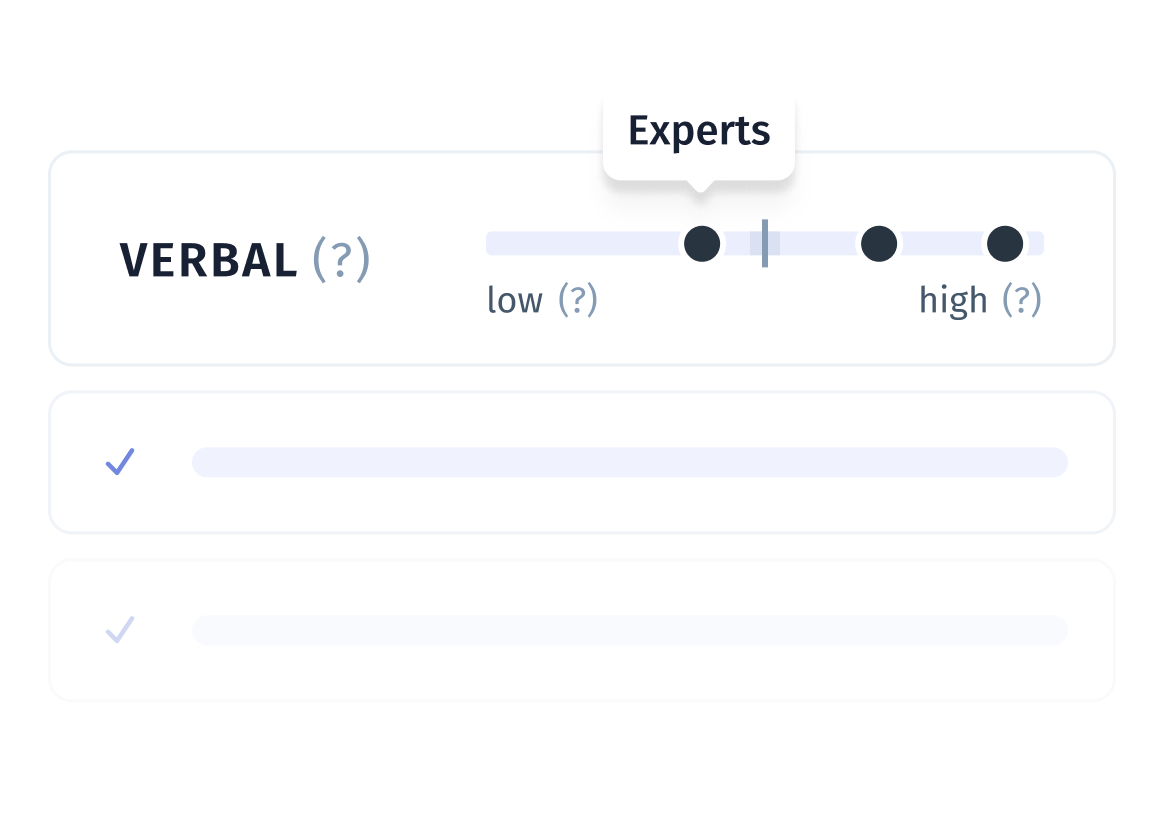
Understand the role
Define what the role really needs together in just a few minutes via a questionnaire – or simply start with a scientifically grounded template.
 2
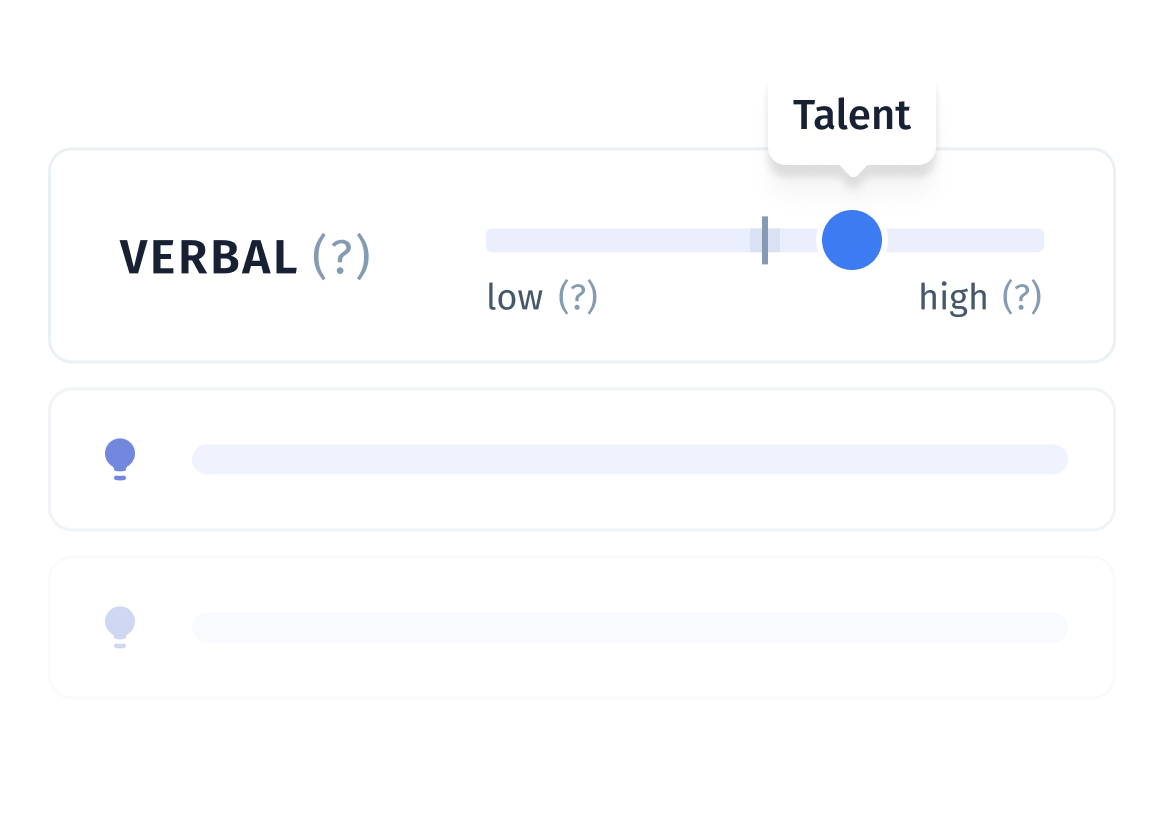
Spot talent
Short, mobile assessments help you spot motivated applicants early – without the hurdles of traditional assessments.
 3
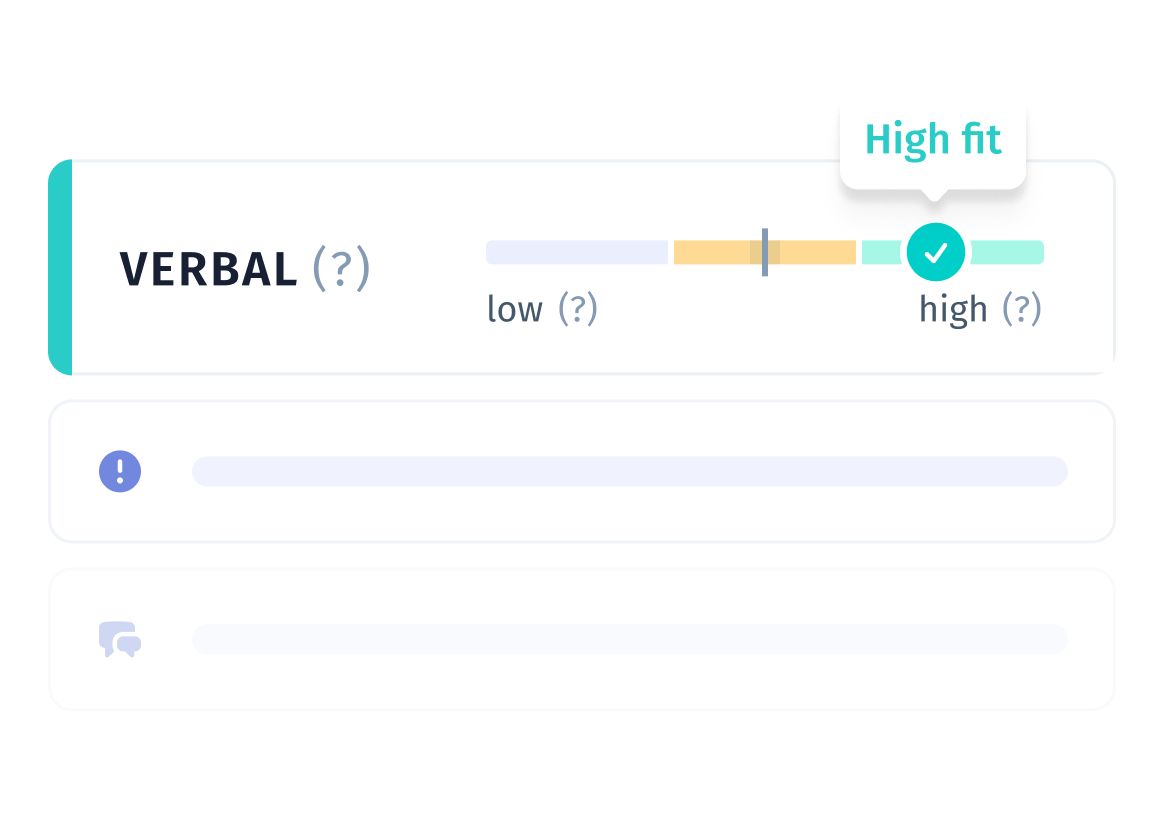
Fit at a glance
So even before the first interview you already see how well a person fits your requirements.
Four perspectives. Because a CV doesn't show everything.
Aivy makes visible what CVs often don't show: abilities, personality, values and professional interests – compared against the requirements of the role and the company.
Abilities
Can a person handle the core requirements of the role? Aivy captures cognitive and social abilities on a scientifically sound basis – instead of only inferring them from degrees or work experience.
Personality
How does a person work, decide and react? Aivy captures work-relevant personality traits and matches them against the requirements of the role.
Values & culture
Which work environment suits a person? Aivy compares individual work preferences with your company culture.
Professional interests
Which activities appeal to a person? Aivy captures professional interests and matches them against the activity field of the role.
How applicants experience Aivy
The video shows you how the assessments are built and how they feel in use.
Scientifically developed. Proven in practice.


The key questions on rollout, acceptance and data protection.
How can Aivy be explained internally in an understandable way?
How do we involve the hiring department meaningfully?
Does Aivy fit into our existing recruiting process?
How do applicants respond to the assessments?
How robust are the results?
How do we handle data protection and the works council?
Does Aivy pay off for our company?
Assess as many people as you like.
No price per assessment, no credits. Tell us how many positions you fill per year – we’ll show you the right plan and what it costs.
Your plan
For this, you assess around 500 people a year and have about 4 positions open at the same time.
For 10 hires a year, Start fits: 5 concurrent open positions and room for 250 talents.
Features
Highlighted is the plan based on your inputs.





Unlimited
For high volumes and comprehensive requirements. Unlimited positions, seats and talent storage, individual contract, custom API and multi-location management included.
What’s in it for you?
Calculated with 10 hires a year from your plan above and 50 applications per hire.
All prices plus VAT · Valid from September 2026
One account per company, no use for third parties, no resale.
Answers to the most important questions.
Aivy is a platform for scientifically grounded talent assessments and job matching. Companies first define which abilities, personality traits, values and interests matter for a role. Applicants then complete the matching assessments. Both sides come together in a fit profile that supports pre-selection and interview preparation.
Aivy is suited to companies that hire repeatedly and want to make their selection more structured, transparent and efficient. The benefit is greatest with high application volumes, several departments involved or comparable role profiles – for example in apprenticeships, entry-level, career changers and specialist recruiting.
The assessments are tailored to the requirements of each role. Depending on the requirement profile, they capture cognitive and social abilities, relevant personality traits, values or company culture, and professional interests. As a result, not every role runs through the same standard test.
The first step is to define the role's requirement profile. Aivy then automatically assembles a matching test battery. After participation, the results are compared with the requirements and presented in a clear fit profile.
The duration depends on which attributes matter for the role and which test procedures are selected. In many cases applicants need around 15 to 30 minutes. It can be completed on a smartphone or a computer.
Recruiters see how the measured attributes match the previously defined requirements. Alongside the overall picture, individual strengths, possible deviations and relevant angles for the interview become visible. This makes it easier to understand why a person could be interesting for a role.
No. Aivy structures requirements, captures relevant attributes and makes fit transparent. The software replaces neither professional judgement nor the personal interview, and it makes no automatic hiring decision. It provides an additional, standardized basis for decisions.
Aivy was developed in line with the requirements of DIN 33430 for job-related aptitude diagnostics. The procedures used are examined for their psychometric quality. This includes objectivity, reliability and validity, among other criteria. In addition, the test batteries and the matching are reviewed and refined in practical use.
Processing is purpose-bound and based on the agreed data protection arrangements. Aivy provides a data processing agreement as well as information on the technical and organizational protective measures. The data is processed on servers in Frankfurt. Access rights and retention periods can be set according to each specific use.
Yes. Aivy can be used directly through its own dashboard or embedded into existing applicant tracking systems. Depending on the system, integration happens via an existing interface, a plug-in or a custom API connection. We determine the right path based on your existing system landscape.
To get started, you first choose a specific role or a clearly defined use case. Then the requirement profile, the position in the recruiting process and the desired way of presenting results are set up. Many companies begin with a limited pilot and then extend the process to further roles.
As many as your process brings in. There is no price per assessment and no credits – nobody on your team has to weigh up whether one more assessment is worth it. That is exactly the point: as soon as every assessment costs money, the people who look unremarkable on paper slip through the net.
For the model to work, there is a limit – not on assessments, but on how many talents sit with you at the same time: 250 in Start, 2,000 in Growth, 5,000 in Scale, plus 50 for every additional position you book. Closed processes, rejections and deletion periods free up space automatically.
You don’t have to keep count. When you get close to the limit, we will get in touch beforehand. Nothing is switched off and nothing is charged without your consent.
There are exactly three, and we will flag all three in advance.
More positions open at the same time than included: add them, €119 per position per month in Start. No change of plan needed.
More people need access: add them, €69 per seat. No upper limit in Growth and Scale; up to five in Start – beyond that, Growth is the better fit, because you will then also need roles and permissions.
Talent storage full: Nothing is lost. New results are saved and shown as soon as space frees up or you switch plans. At 80%, we will get in touch – and work out together what the next plan brings and costs.
You pay for the plan, not the position. The base price covers features, seats, talent storage and support – the positions are the frame in which you use them. That is why an included position in Scale is, on paper, even more expensive than in Growth (around €90 instead of €75): there is more in it.
Additional positions are the bridge to the next plan. At the end of the bridge, you are just below the base price of the next plan: Growth with 38 positions costs €4,172, Scale with 50 positions €4,490. For €318 more, you immediately get twelve more positions, 15 more seats and 2,100 more talents of storage – and up to 50 positions, nothing more is added after that. The same applies one level up: Scale with 68 positions costs €8,072, Unlimited from €8,490.
That is why every plan ends where the next one costs hardly any more. A Growth plan without a limit would only be slightly cheaper than Scale at 39 or 40 positions; from 41 positions, Scale is cheaper because positions up to 50 are included there. The higher Scale add-on price only catches up with that lead from 80 positions – but from 69 positions, Unlimited already applies.
The number of hiring processes running in parallel – not the number of positions you fill per year.
Every position has its own requirement profile: what really leads to success in that role, and which methods measure it. That is why the position is the unit. A profile for inside sales says nothing about an apprenticeship in logistics.
Some positions run for a few weeks, others permanently. Once one is filled, you close it and the slot is free again straight away – so you decide which role takes up a slot. The requirement profile stays with you: if the same role opens again in a year, you start with everything you learned last time.
Didn't find it? Write to us.